Reporting on the developments of 3D printing, rapid manufacturing and other technologies that are going to change our physical environment.
Sunday, January 29, 2012
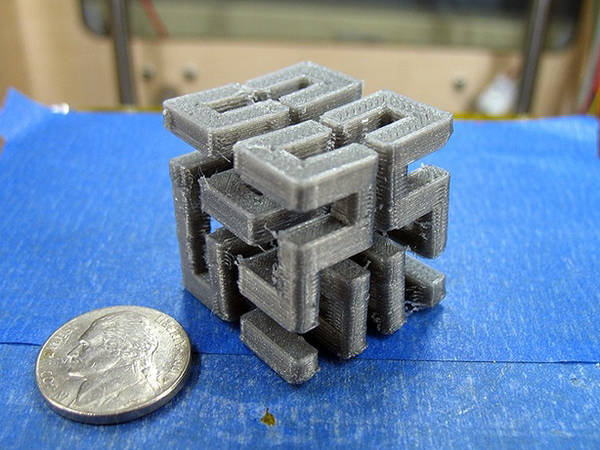
3D printed Hilbert curve using two types of ink
This Hilbert curve approximation serves more as a test "to produce objects with overhanging parts that are currently very difficult, or impossible, for them to print" using two types of ink (PVA and PLA). After dissolving the former, the latter remains.
Next up, a Menger sponge?
Approximating the Hilbert curve with 3D printers (BoingBoing via Thingiverse)
Labels:
3d printer,
development,
hilbert curve,
menger sponge,
pla,
pva
Wednesday, January 25, 2012
Advocating U.S. manufacturing jobs through 3D printing
Michael Heisenberg at Seeking Alpha has an opinion post about the decline of American manufacturing and how to turn the tide. The solution: get the 3D printing industry going in the US. Interestingly, he cites the iPhone as an example of how America lost the battle. (As he talks about the iPhone, I suggest you read my manifesto Death to centralized manufacturing, long live 3D printing--or why Apple should venture into printers.)
Obama's leapfrog is to turn America into the Global leader in local production by investing heavily in 3D printing and the maker class. In the same way that the Chinese government invested in glass factories that ultimately won business for iPhone production, America can start manufacturing again by setting up centers of low cost, mass customized production via 3D printing and this should be done locally. America's innovative class is already leading in 3D printing with the Maker Movement, making waves and gathering a following.
What is missing is ubiquity and lower costs. As a number of commenters discussed on Fred Wilson's AVC blog, cost and ubiquity still stand in the way of an explosion in 3D printing but it will come and when it does, America should want to be at the forefront because 3D printing can disrupt the current global supply chain. Yes, disrupt the current global supply chain.
Already, private companies are leading the way, 3D Systems (Nasdaq: DDD, Objet (in IPO process) and Shapeways are driving the costs of 3D printing lower (ironically Objet (Israel) and Shapeways (great prezi)(Netherlands) are both non-US companies) and making mass customization cheaper and more accessible. However, if you want to leapfrog, you need to go all-in. By subsidizing and encouraging the building of local infrastructure, retraining middle class manufacturing to start and operate 3D printing facilities and by building global/local supply chains by investing massively in 3D printing facilities, Obama can start altering the global supply chain dynamics.How Barack Obama Can Bring Manufacturing Jobs Back To America (seekingalpha.com)
Labels:
3d printing,
china,
investment,
jobs,
local,
maker movement,
manufacturing,
usa
3D printing special at Bloomberg Businessweek: space, home, organs and more
I missed this a couple of weeks ago, but Bloomberg Businessweek had a special about 3D printing. They need to cater to their target audience but I'm sure that these articles are well-appreciated by CEOs and non-CEOs alike!
3D Printing Coming to the Manufacturing Space—and Outer Space
As more companies use 3D printers to make finished products, not prototypes, NASA may use them to make parts and tools on the International Space Station
3D Printer Makers Aim at Home Market
As vendors such as 3D Systems and Stratasys begin selling devices that let consumers print out toys and replacement parts, will kids start producing their own toys?
Bioprinting: The 3D Future of Organ Transplants?
Printers that use human cells to create functional, living tissue may ultimately facilitate organ transplants for an aging population
Slide Show: Ten Products Printed in 3D
Using silver, glass, and plastics, 3D printers can turn out toys, jewelry, dresses, furniture—and even a hybrid auto
Podcast: Using a Printer to Make Products
Today it's possible to print airplane parts, jewelry, and shoes, much like you'd print a document. Companies such as Boeing are using 3D printing—also known as additive manufacturing— to make complex parts for military jets
Tuesday, January 24, 2012
The Pirate Bay offers models of physical objects for download
A pirate-ship model can be printed out from a physible file, now hosted on The Pirate Bay.
(Screenshot by Luke Hopewell/ZDNet Australia)
|
ThePirateBay.org, everyone's go-to site for torrent downloads, has ventured into offering 3D models ("physibles") that users can print at home (whether copyrighted or not):
We believe that the next step in copying will be made from digital form into physical form. It will be physical objects. Or as we decided to call them: Physibles. Data objects that are able (and feasible) to become physical. We believe that things like three dimensional printers, scanners and such are just the first step. We believe that in the nearby future you will print your spare sparts for your vehicles. You will download your sneakers within 20 years.
Labels:
3d printer,
copyright,
design,
distribution,
physibles,
pirate bay
Sunday, January 22, 2012
Make sure to rinse out the plastic residues: 3D printer prints chocolate, cheese
I predict a rise in algorithmically generated cupcakes... Imagine the endless possibilities (this will be a hoot in the wedding cake industry I'm sure!)
Imagine 3D is not your regular printer as its syringes may be filled with chocolate. Yes, a chocolate-flavoured print job that Essential Dynamics is hoping would find a market as it pushes for 3D printing.
It’s not just chocolate that the printer’s syringe may be filled with, you may also add cheese, silicone, epoxy and concrete tom make your printed copy more life-like.
The Imagine 3D, unique as it is, will set you back a whopping $3,000. If you’re really that much of a chocolate lover or love making new stuff and have cash to spare, then this might get your attention.
3D Printer Now Includes Chocolates, Cheese (Geeky Gadgets via Gizmodo via PSFK via Essential Dynamics)
Labels:
3d printer,
algorithmic cupcakes,
essential dynamics,
food
3D printing and construction
3D printing is traditionally a tabletop enterprise: printed products are about a few inches big in each direction. However, another application for 3D printing is emerging that's quite a step up from, say, replacing your missing LEGO bricks: construction.
Txchnologist has a report about a concrete-excreting printer that builds houses. (beware, this website is a pr/marketing front for GE, so if you get a sudden urge to buy a jet engine you know why)
Khoshnevis calls his technique “Contour Crafting” and it operates on roughly the same principle as consumer 3D printers like MakerBot’s Thing-O-Matic. His robot pours out a trail of viscous concrete while tracing along the footprint of a wall. As the nozzle sweeps back and forth, the layers rapidly build, with the lower ones hardening enough to support the increasing weight. Its speed puts construction workers to shame. “We are talking about a technology that can build a square foot of wall in less than 20 seconds,” Khoshnevis says. At that rate, Contour Crafting can put together a whole room in just an hour.
Size is now the only thing holding back the technology. “We have a machine that can build a structure about 23 feet long, about 7 feet high and about 15 feet wide at this point,” says Khoshnevis. He estimates that a full-scale printer would break down into three pieces and be small enough to fit onto a flatbed truck. All construction would happen on site. First, a designer would bring a digital blueprint for the house on a thumb drive and plug it into the printer while workers loaded it with concrete. Once the printer was activated, humans would play a supporting role, laying out supplies for the robotic gripper arm and preparing fresh batches of concrete. Humans would also install the windows and doors, since the task is so easy it’s not worth automating, Khoshnevis previously said.Some modern skyscrapers are already built using a semi-automated process where the central concrete core is continually built up, day and night; however that method doesn't allow for any customizations like the one above.
Although fully automated, fully customizable construction is still a few steps away, a Chinese company called China Broad Group built a 30-story building in 15 days using mostly prefabricated materials (see video up top). The main benefits are not only rapid construction, but also a decreased use of materials and operational energy:
We have been closely tracking China's Broad Group and their prefabricated factory mass produced 'Can be Built' skyscraper technology. Six months ago they had earthquake certified a scale model of their 30 story building. now they have built an actual 30 story building in 15 days at the end of 2011.
This is one of the key technologies to watch for the next decade or two. The reason is the construction methods use far less cement and are more energy efficient. They will also enable faster urbanization of the developing world (not just China.) With state backing Broad Group will have this technology in use for more high rise commercial construction by 2020. This is part of the mundane singularity of technologies that mostly exist now and can high impact on the world. The buildings are five times more energy efficient in operation and use about 6 times less cement.(Via Nextbigfuture.com)
Labels:
3d printing,
china,
concrete,
construction,
development,
house,
skyscraper,
usa
Friday, January 20, 2012
3D printer uses paper as ink
This solid model was created using a 3D printer - no folding required.
Most 3D printers work by laying down layers of a resin or heated plastic material to gradually render a 3D object created by a 3D modeling program. But Mcor Technology's Matrix 3D printer uses paper as the "ink." The technology is a greener way to build 3D prototypes than plastic-jet printers and other 3D printing technologies, and for design shops that keep their 3D printers busy, operating costs can be substantially lower.
Mcor, based in Ireland, has been selling the technology in Europe since 2008, but just began marketing it in the U.S. last year. So far, McCormack says, the company has placed a few hundred machines with architects and product design engineers and is hoping it will catch on in the U.S. as a greener, and lower-cost alterative to the traditional 3D printing technologies.
How it works
Mcor Technologies' Matrix 3D printer builds an object, such as the model airplane shown above, one sheet at a time. It interleaves sheets of everyday office printer paper with layers of an adhesive that binds them. As the object rises up from the print surface (it takes 10 sheets of paper to build up 1 millimeter of height), tungsten carbide blades sculpt away excess paper that is not part of the design, creating a finished object up to 400 cubic inches in size.
Objects can be rendered in color by varying the color in the paper bin.This 3D printer uses paper as the ink (ComputerWorld)
Subscribe to:
Posts (Atom)