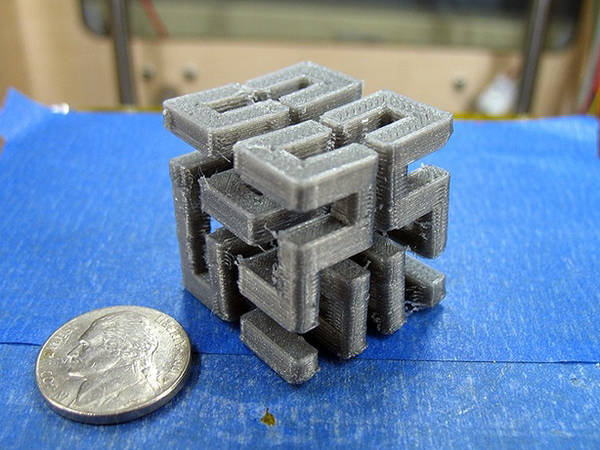
3D printing is traditionally a tabletop enterprise: printed products are about a few inches big in each direction. However, another application for 3D printing is emerging that's quite a step up from, say, replacing your missing LEGO bricks: construction.
Txchnologist has a report about a concrete-excreting printer that builds houses. (beware, this website is a pr/marketing front for GE, so if you get a sudden urge to buy a jet engine you know why)
Khoshnevis calls his technique “Contour Crafting” and it operates on roughly the same principle as consumer 3D printers like MakerBot’s Thing-O-Matic. His robot pours out a trail of viscous concrete while tracing along the footprint of a wall. As the nozzle sweeps back and forth, the layers rapidly build, with the lower ones hardening enough to support the increasing weight. Its speed puts construction workers to shame.
“We are talking about a technology that can build a square foot of wall in less than 20 seconds,” Khoshnevis says. At that rate, Contour Crafting can put together a whole room in just an hour.
Size is now the only thing holding back the technology. “We have a machine that can build a structure about 23 feet long, about 7 feet high and about 15 feet wide at this point,” says Khoshnevis.
He estimates that a full-scale printer would break down into three pieces and be small enough to fit onto a flatbed truck. All construction would happen on site. First, a designer would bring a digital blueprint for the house on a thumb drive and plug it into the printer while workers loaded it with concrete. Once the printer was activated, humans would play a supporting role, laying out supplies for the robotic gripper arm and preparing fresh batches of concrete. Humans would also install the windows and doors, since the task is so easy it’s not worth automating, Khoshnevis previously said.
Some modern skyscrapers are already built using a semi-automated process where the central concrete core is continually built up, day and night; however that method doesn't allow for any customizations like the one above.
Although fully automated, fully customizable construction is still a few steps away, a Chinese company called China Broad Group
built a 30-story building in 15 days using mostly prefabricated materials (see video up top). The main benefits are not only rapid construction, but also a decreased use of materials and operational energy:
We have been closely tracking China's Broad Group and their prefabricated factory mass produced 'Can be Built' skyscraper technology. Six months ago they had earthquake certified a scale model of their 30 story building. now they have built an actual 30 story building in 15 days at the end of 2011.
This is one of the key technologies to watch for the next decade or two. The reason is the construction methods use far less cement and are more energy efficient. They will also enable faster urbanization of the developing world (not just China.) With state backing Broad Group will have this technology in use for more high rise commercial construction by 2020. This is part of the mundane singularity of technologies that mostly exist now and can high impact on the world.
The buildings are five times more energy efficient in operation and use about 6 times less cement.
(Via Nextbigfuture.com)