The combination of FDM 3D printing and printed electronics technologies can provide benefits over traditional prototyping, manufacturing and field repair processes. Performance and functionality of products can be improved in two ways: 3D printers enable lighter weight mechanical structures; and conformal electronics printed directly onto the structure frees up space for additional payload. In turn, the process has a positive impact on the environment by using fewer materials.
Next big thing: writing the software that integrates electronics with 3D printing.
Maggie Koerth-Baker at BoingBoing rounds up two arguments being made on 3D printing at Technology Review, by Christopher Mims and Tim Maly: are we being too one-sided and optimistic?
Mims' argument:
As 3-D printers come within reach of the hobbyist—$1,100 for MakerBot's Thing-O-Matic—and The Pirate Bay declares "physibles" the next frontier of piracy, I'm seeing usually level-headed thinkers like Clive Thompson and Tim Maly declare that the end of shipping is here and we should all start boning up on Cory Doctorow's science fiction fantasies of a world in which any object can be rapidly synthesized with a little bit of energy and raw materials.
This isn't just premature, it's absurd. 3-D printing, like VR before it, is one of those technologies that suggest a trend of long and steep adoption driven by rapid advances on the systems we have now. And granted, some of what's going on at present is pretty cool—whether it's in rapid prototyping, solid-fuel rockets, bio-assembly or just giant plastic showpieces.
Maly:
Chris is right that 3-D printing as it stands isn't a replacement for the contemporary industrial supply chain. It's clearly a transitional technology. The materials suck. The resolution is terrible. The objects are fragile. You can't recycle the stuff.
Maybe early home 3-D printers use only plastic and can only make objects that fall within certain performance restrictions. Maybe it starts out as, like, jewelry, the latest model toys, and parts for Jay Leno's car. But there's no way that lasts. People are already working on the problem. They are working especially hard on the materials problem.
At the same time, it's not hard to imagine a convergence from the other direction. Some materials and formats will fall out of favor because they are hard to make rapidly. Think of how most documents are 8.5×11 (or A4) these days. It's just not worth the hassle of wrangling dozens of paper formats.
3D printing enjoys hypes similar to VR, nanotech and hydrogen cars. These things never turn out the way they were intended. Will we ever print iPhones? Maybe, maybe not. By the time it's possible, mobile technology will be way beyond iPhones so arguing that it's possible is analogous to "winning the previous war". We'll see where 3D printing will take us because we don't define technology's future; it defines ours.
Some interesting comments and predictions about 3D printing in the article below by Denis McEvoy. Just as we can now legally download movies and get digital TV or get pirated content via Pirate Bay, there will probably some form of dualism in the 3D printing sphere: either you can get a copyrighted 3D model you can print on a sanctioned 3D printer within a sanctioned ecosystem, a la App Store, or a free market where you can download objects for free that are either copyrighted or not. The latter already exists (Pirate Bay's Physibles)... (The intersection between copyright and 3D printing was already covered in this earlier post.)
This technology will completely change the world beyond any of our comprehensions. The effects will be extreme and wide-ranging. Over a relatively short space of time most factories could become useless, thousands of jobs would be lost and shipping and post would reduce dramatically.
The new system of downloading everything from your food to condoms will likely see piracy remain as a major problem. Companies will probably sell us the digital blueprints of the items we want and then we'll make them in our next-generation printer. This will leave every possible product open to being pirated. How that will be curbed is something few people have even begun to think about.
I wrote about 3D printing and Apple a long time ago (Death to Centralized Manufacturing). The Atlantic thinks that Apple could benefit from putting out a 3D printer. I'd say the same, only I don't think Apple would want to sell it as a product: much rather they would use a 3D printer to make parts or even whole products using a 3D printer. If it becomes possible to print, say, an iPhone, then why would they sell a device that could potentially undermine their business?
Already Apple is using specialized machines (with lasers and all) to mill the aluminum bodies of MacBook Pros, iMacs and iPhones--in the MacBook Pro case, they went with the same machines for production as during the design and prototyping phase. And their subcontractor Foxconn is already talking about replacing workers with robots in the manufacturing process. So if 3D printing is not in the cards for Apple yet then definitely full-scale automation.
If a former-raver and artist could find fun and value in the $1,100 machine, maybe a lot of people might. And he did. "It took me a week to assemble my Makerbot, but remember that when Jobs and Wozniak and those guys first started out, you had to make your own computer," he said. "Now they're in your pocket. That's where I think this is headed." (Are you listening, Apple?)
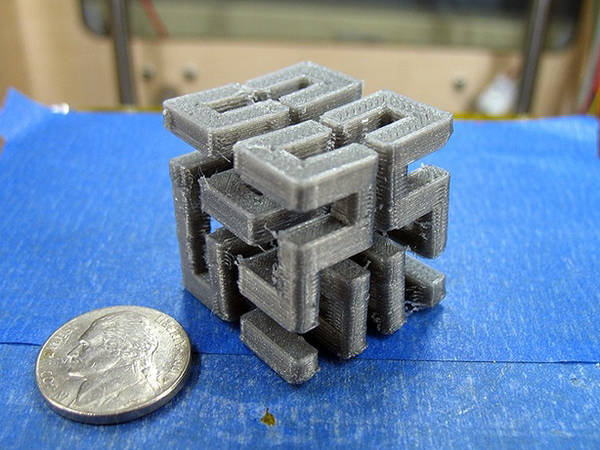
This Hilbert curve approximation serves more as a test "to produce objects with overhanging parts that are currently very difficult, or impossible, for them to print" using two types of ink (PVA and PLA). After dissolving the former, the latter remains.
Michael Heisenberg at Seeking Alpha has an opinion post about the decline of American manufacturing and how to turn the tide. The solution: get the 3D printing industry going in the US. Interestingly, he cites the iPhone as an example of how America lost the battle. (As he talks about the iPhone, I suggest you read my manifesto Death to centralized manufacturing, long live 3D printing--or why Apple should venture into printers.)
Obama's leapfrog is to turn America into the Global leader in local production by investing heavily in 3D printing and the maker class. In the same way that the Chinese government invested in glass factories that ultimately won business for iPhone production, America can start manufacturing again by setting up centers of low cost, mass customized production via 3D printing and this should be done locally. America's innovative class is already leading in 3D printing with the Maker Movement, making waves and gathering a following.
What is missing is ubiquity and lower costs. As a number of commenters discussed on Fred Wilson's AVC blog, cost and ubiquity still stand in the way of an explosion in 3D printing but it will come and when it does, America should want to be at the forefront because 3D printing can disrupt the current global supply chain. Yes, disrupt the current global supply chain.
Already, private companies are leading the way, 3D Systems (Nasdaq: DDD, Objet (in IPO process) and Shapeways are driving the costs of 3D printing lower (ironically Objet (Israel) and Shapeways (great prezi)(Netherlands) are both non-US companies) and making mass customization cheaper and more accessible. However, if you want to leapfrog, you need to go all-in. By subsidizing and encouraging the building of local infrastructure, retraining middle class manufacturing to start and operate 3D printing facilities and by building global/local supply chains by investing massively in 3D printing facilities, Obama can start altering the global supply chain dynamics.
I missed this a couple of weeks ago, but Bloomberg Businessweek had a special about 3D printing. They need to cater to their target audience but I'm sure that these articles are well-appreciated by CEOs and non-CEOs alike!
As more companies use 3D printers to make finished products, not prototypes, NASA may use them to make parts and tools on the International Space Station
As vendors such as 3D Systems and Stratasys begin selling devices that let consumers print out toys and replacement parts, will kids start producing their own toys?
Today it's possible to print airplane parts, jewelry, and shoes, much like you'd print a document. Companies such as Boeing are using 3D printing—also known as additive manufacturing— to make complex parts for military jets
A pirate-ship model can be printed out from a physible file, now hosted on The Pirate Bay.
(Screenshot by Luke Hopewell/ZDNet Australia)
ThePirateBay.org, everyone's go-to site for torrent downloads, has ventured into offering 3D models ("physibles") that users can print at home (whether copyrighted or not):
We believe that the next step in copying will be made from digital form into physical form. It will be physical objects. Or as we decided to call them: Physibles. Data objects that are able (and feasible) to become physical. We believe that things like three dimensional printers, scanners and such are just the first step. We believe that in the nearby future you will print your spare sparts for your vehicles. You will download your sneakers within 20 years.
I predict a rise in algorithmically generated cupcakes... Imagine the endless possibilities (this will be a hoot in the wedding cake industry I'm sure!)
Imagine 3D is not your regular printer as its syringes may be filled with chocolate. Yes, a chocolate-flavoured print job that Essential Dynamics is hoping would find a market as it pushes for 3D printing.
It’s not just chocolate that the printer’s syringe may be filled with, you may also add cheese, silicone, epoxy and concrete tom make your printed copy more life-like.
The Imagine 3D, unique as it is, will set you back a whopping $3,000. If you’re really that much of a chocolate lover or love making new stuff and have cash to spare, then this might get your attention.
3D printing is traditionally a tabletop enterprise: printed products are about a few inches big in each direction. However, another application for 3D printing is emerging that's quite a step up from, say, replacing your missing LEGO bricks: construction.
Txchnologist has a report about a concrete-excreting printer that builds houses. (beware, this website is a pr/marketing front for GE, so if you get a sudden urge to buy a jet engine you know why)
Khoshnevis calls his technique “Contour Crafting” and it operates on roughly the same principle as consumer 3D printers like MakerBot’s Thing-O-Matic. His robot pours out a trail of viscous concrete while tracing along the footprint of a wall. As the nozzle sweeps back and forth, the layers rapidly build, with the lower ones hardening enough to support the increasing weight. Its speed puts construction workers to shame.
“We are talking about a technology that can build a square foot of wall in less than 20 seconds,” Khoshnevis says. At that rate, Contour Crafting can put together a whole room in just an hour.
Size is now the only thing holding back the technology. “We have a machine that can build a structure about 23 feet long, about 7 feet high and about 15 feet wide at this point,” says Khoshnevis.
He estimates that a full-scale printer would break down into three pieces and be small enough to fit onto a flatbed truck. All construction would happen on site. First, a designer would bring a digital blueprint for the house on a thumb drive and plug it into the printer while workers loaded it with concrete. Once the printer was activated, humans would play a supporting role, laying out supplies for the robotic gripper arm and preparing fresh batches of concrete. Humans would also install the windows and doors, since the task is so easy it’s not worth automating, Khoshnevis previously said.
Some modern skyscrapers are already built using a semi-automated process where the central concrete core is continually built up, day and night; however that method doesn't allow for any customizations like the one above.
Although fully automated, fully customizable construction is still a few steps away, a Chinese company called China Broad Group built a 30-story building in 15 days using mostly prefabricated materials (see video up top). The main benefits are not only rapid construction, but also a decreased use of materials and operational energy:
We have been closely tracking China's Broad Group and their prefabricated factory mass produced 'Can be Built' skyscraper technology. Six months ago they had earthquake certified a scale model of their 30 story building. now they have built an actual 30 story building in 15 days at the end of 2011.
This is one of the key technologies to watch for the next decade or two. The reason is the construction methods use far less cement and are more energy efficient. They will also enable faster urbanization of the developing world (not just China.) With state backing Broad Group will have this technology in use for more high rise commercial construction by 2020. This is part of the mundane singularity of technologies that mostly exist now and can high impact on the world.
The buildings are five times more energy efficient in operation and use about 6 times less cement.
One excellent aspect of this is that you don't need to add structural support while printing, something required with resin or plastic. I wonder though what the impact could be on the accuracy of the products, caused by margin of error in paper thickness.
This solid model was created using a 3D printer - no folding required.
Most 3D printers work by laying down layers of a resin or heated plastic material to gradually render a 3D object created by a 3D modeling program. But Mcor Technology's Matrix 3D printer uses paper as the "ink." The technology is a greener way to build 3D prototypes than plastic-jet printers and other 3D printing technologies, and for design shops that keep their 3D printers busy, operating costs can be substantially lower.
Mcor, based in Ireland, has been selling the technology in Europe since 2008, but just began marketing it in the U.S. last year. So far, McCormack says, the company has placed a few hundred machines with architects and product design engineers and is hoping it will catch on in the U.S. as a greener, and lower-cost alterative to the traditional 3D printing technologies.
How it works
Mcor Technologies' Matrix 3D printer builds an object, such as the model airplane shown above, one sheet at a time. It interleaves sheets of everyday office printer paper with layers of an adhesive that binds them. As the object rises up from the print surface (it takes 10 sheets of paper to build up 1 millimeter of height), tungsten carbide blades sculpt away excess paper that is not part of the design, creating a finished object up to 400 cubic inches in size.
Objects can be rendered in color by varying the color in the paper bin.
The fun thing about a disruptive technology like 3D printing, is that its utility and destiny is defined along the way. Right now, playsets are the thing in 3D printing.
From BoingBoing:
MakerBot has announced "MakerBot Playsets," a series of freely downloadable dollhouses, furnishings and dolls for your 3D printer. Whip up as pieces as needed, on demand, and amaze the wee ones (and compulsive hoarders) in your life.
So without further ado, straight from the soundstage backlot of Annelise’s Replicator music video, The Right Heart, we present you with the MakerBot Fairytale Castle Playset and the Damsels!
MakerBot’s own design superstar Michael “Skimbal” Curry, creator of such Thingiverse megahits as the Turtle Shell Racers and Gothic Cathedral playset, starts the ball rolling by architecting a pair of MakerBot Playset buildings. Introducing two new Thingiverse superstars: Cushwa and PrettyLittleThings are doing a tremendous job furnishing these playsets with their imaginations.1
The notion I find most seductive when it comes to 3D printing is its parallels to digital distribution. If I want something, I can find it on the Internet and zap it right into the home — my 3D printer will whip it up. We're not there yet, but we've got a little peek of that future through MakerBot Playsets.
The beauty of a project such as the MakerBot Playsets is that a couple of super skilled designers can create something that everyone can enjoy. Sadly, since 3D printers are a little more expensive than toasters — though they're definitely getting more and more affordable — said "everyone" is still a pretty small group.
Still, you can't help but love the work done here. The mastermind of the playset is Michael "Skimbal" Curry, whose work we've showed off before, with help from other designers around the Thingiverse, MakerBot's 3D printing community hub. Curry can crank out the framework and a few models, and then others can come in and fill, say, a doll-sized television or egg-shaped chair.
Dylan Tweney at VentureBeat.com has something to say about the intersection between 3D printing, the American pioneering spirit and current countermovements in contemporary culture and politics.
“We have a consumer product that’s anti-consumerist,” MakerBot Industries founder Bre Pettis told me at CES 2012, where I captured the short video below. “When you get a MakerBot, you have an alternative to buying things. You can download them … or you can design something and make it custom yourself.”
(...) I’m convinced that the people who have embraced the DIY movement have tapped into the core of what makes the United States great: Self-reliance, experimentation, innovation and a non-dogmatic reverence for facts. Over the decades, innovators tinkering in metaphorical (or literal) garages have played important roles in the development of electricity, radio, computers and, now, the internet economy.
DIY, or at least a willingness to take initiative for doing things on one’s own, outside the usual structures, has also played a role in political life, with grassroots organizations like MoveOn.org and loosely organized movements like the Tea Party and Occupy Wall Street drawing much of their strength from people’s iconoclasm and sense of self-sufficiency.
Konica Minolta 3D Scanning Labs announced today its new rapid prototyping service. The company is now offering 3D printing services with the addition of 3D Systems' Projet(TM) HD 3000 3D Production System. The Projet(TM) is ideal for a wide-range of applications including concept development, design validation, form and fit analysis, molding and casting patterns, investment casting of jewelry and other fine feature applications.
The $10 million in venture capital for MakerBot is beginning to pay off I think. Sure, $2000 for the new MakerBot Replicator (CNET) is quite a steep price, but I think it fills a gap between the hobby crowd (read: Cube) and professional additive manufacturing, where printers usually cost in the tens of thousands. From the link:
One barrier to wider adoption might be price. The fully-featured Replicator, the model with dual extruders for printing two-color objects, costs $2,000. The monocolor Cube costs $1,300. Spools of ABS plastic, the printers' chief consumable, go for $50. Those figures aren't entirely out of reach, but they do put 3D printing out of Wal-mart.
I'm sure that in the not-too-distant future, we'll see the Replicator's price go below $1000. We're at a stage where the home computer was, say, 25 years ago.
Sometime in the next few months, 3D Systems will start selling a new Cube 3D printer priced at $1299 that comes with a cartridge of plastic available in ten colors. The printer is 14-by-14-by-18 inches, weighs less than 9 pounds, and can print about ten to twelve "average size" parts, which Rajeev Kulkarni, 3D Systems VP and general manager of consumer solutions, says works out to be about $4 to $5 per part. When it’s time to reorder a new cartridge, the cost is $50.
One thing: after living through 20 years of inkjet cartridge fascism, I seriously hope the future of 3D printing comes without cartridges. Thank you very much.