Monday, March 26, 2012

Combining 3D printing with electronics printing

Via Nextbigfuture.com:
The combination of FDM 3D printing and printed electronics technologies can provide benefits over traditional prototyping, manufacturing and field repair processes. Performance and functionality of products can be improved in two ways: 3D printers enable lighter weight mechanical structures; and conformal electronics printed directly onto the structure frees up space for additional payload. In turn, the process has a positive impact on the environment by using fewer materials.
Next big thing: writing the software that integrates electronics with 3D printing.

Revolutionary "Smart Wing" Created for UAV Model Demonstrates 3D Printing is Merged with Printed Electronics

Wednesday, February 1, 2012

Are we being too one-sided and optimistic about 3D printing?

Maggie Koerth-Baker at BoingBoing rounds up two arguments being made on 3D printing at Technology Review, by Christopher Mims and Tim Maly: are we being too one-sided and optimistic?

Mims' argument:
As 3-D printers come within reach of the hobbyist—$1,100 for MakerBot's Thing-O-Matic—and The Pirate Bay declares "physibles" the next frontier of piracy, I'm seeing usually level-headed thinkers like Clive Thompson and Tim Maly declare that the end of shipping is here and we should all start boning up on Cory Doctorow's science fiction fantasies of a world in which any object can be rapidly synthesized with a little bit of energy and raw materials.

This isn't just premature, it's absurd. 3-D printing, like VR before it, is one of those technologies that suggest a trend of long and steep adoption driven by rapid advances on the systems we have now. And granted, some of what's going on at present is pretty cool—whether it's in rapid prototyping, solid-fuel rockets, bio-assembly or just giant plastic showpieces.
Maly:
Chris is right that 3-D printing as it stands isn't a replacement for the contemporary industrial supply chain. It's clearly a transitional technology. The materials suck. The resolution is terrible. The objects are fragile. You can't recycle the stuff. 
Maybe early home 3-D printers use only plastic and can only make objects that fall within certain performance restrictions. Maybe it starts out as, like, jewelry, the latest model toys, and parts for Jay Leno's car. But there's no way that lasts. People are already working on the problem. They are working especially hard on the materials problem. 
At the same time, it's not hard to imagine a convergence from the other direction. Some materials and formats will fall out of favor because they are hard to make rapidly. Think of how most documents are 8.5×11 (or A4) these days. It's just not worth the hassle of wrangling dozens of paper formats. 
3D printing enjoys hypes similar to VR, nanotech and hydrogen cars. These things never turn out the way they were intended. Will we ever print iPhones? Maybe, maybe not. By the time it's possible, mobile technology will be way beyond iPhones so arguing that it's possible is analogous to "winning the previous war". We'll see where 3D printing will take us because we don't define technology's future; it defines ours.

Is 3D printing the new virtual reality? (BoingBoing)
Why 3-D Printing Will Go the Way of Virtual Reality (Technology Review)
Why 3-D Printing Isn't Like Virtual Reality (Technology Review)

Tuesday, January 31, 2012

Copyright and 3D printers

Some interesting comments and predictions about 3D printing in the article below by Denis McEvoy. Just as we can now legally download movies and get digital TV or get pirated content via Pirate Bay, there will probably some form of dualism in the 3D printing sphere: either you can get a copyrighted 3D model you can print on a sanctioned 3D printer within a sanctioned ecosystem, a la App Store, or a free market where you can download objects for free that are either copyrighted or not. The latter already exists (Pirate Bay's Physibles)... (The intersection between copyright and 3D printing was already covered in this earlier post.)

This technology will completely change the world beyond any of our comprehensions. The effects will be extreme and wide-ranging. Over a relatively short space of time most factories could become useless, thousands of jobs would be lost and shipping and post would reduce dramatically. 
The new system of downloading everything from your food to condoms will likely see piracy remain as a major problem. Companies will probably sell us the digital blueprints of the items we want and then we'll make them in our next-generation printer. This will leave every possible product open to being pirated. How that will be curbed is something few people have even begun to think about.

Printing a new iPhone, a pair of runners - or even your dinner (Joe.ie)

Monday, January 30, 2012

Apple and 3D Printers: why I don't think it's going to work

I wrote about 3D printing and Apple a long time ago (Death to Centralized Manufacturing). The Atlantic thinks that Apple could benefit from putting out a 3D printer. I'd say the same, only I don't think Apple would want to sell it as a product: much rather they would use a 3D printer to make parts or even whole products using a 3D printer. If it becomes possible to print, say, an iPhone, then why would they sell a device that could potentially undermine their business?

Already Apple is using specialized machines (with lasers and all) to mill the aluminum bodies of MacBook Pros, iMacs and iPhones--in the MacBook Pro case, they went with the same machines for production as during the design and prototyping phase. And their subcontractor Foxconn is already talking about replacing workers with robots in the manufacturing process. So if 3D printing is not in the cards for Apple yet then definitely full-scale automation.
If a former-raver and artist could find fun and value in the $1,100 machine, maybe a lot of people might. And he did. "It took me a week to assemble my Makerbot, but remember that when Jobs and Wozniak and those guys first started out, you had to make your own computer," he said. "Now they're in your pocket. That's where I think this is headed." (Are you listening, Apple?)
Why Apple Should Start Making a 3D Printer Right Now (The Atlantic)

Sunday, January 29, 2012

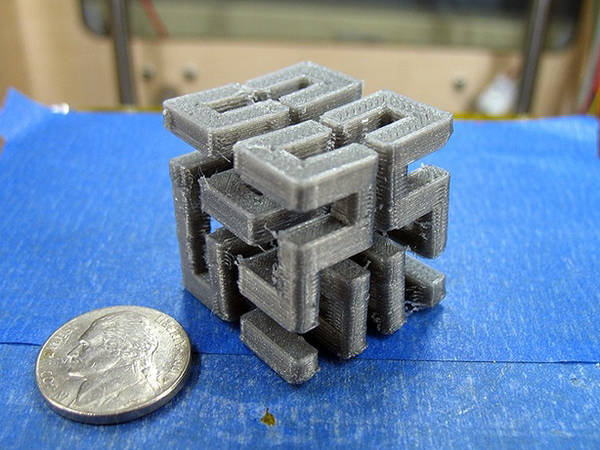
3D printed Hilbert curve using two types of ink


This Hilbert curve approximation serves more as a test "to produce objects with overhanging parts that are currently very difficult, or impossible, for them to print" using two types of ink (PVA and PLA). After dissolving the former, the latter remains.

Next up, a Menger sponge?

Approximating the Hilbert curve with 3D printers (BoingBoing via Thingiverse)

Wednesday, January 25, 2012

Advocating U.S. manufacturing jobs through 3D printing

Michael Heisenberg at Seeking Alpha has an opinion post about the decline of American manufacturing and how to turn the tide. The solution: get the 3D printing industry going in the US. Interestingly, he cites the iPhone as an example of how America lost the battle. (As he talks about the iPhone, I suggest you read my manifesto Death to centralized manufacturing, long live 3D printing--or why Apple should venture into printers.)
Obama's leapfrog is to turn America into the Global leader in local production by investing heavily in 3D printing and the maker class. In the same way that the Chinese government invested in glass factories that ultimately won business for iPhone production, America can start manufacturing again by setting up centers of low cost, mass customized production via 3D printing and this should be done locally. America's innovative class is already leading in 3D printing with the Maker Movement, making waves and gathering a following. 
What is missing is ubiquity and lower costs. As a number of commenters discussed on Fred Wilson's AVC blog, cost and ubiquity still stand in the way of an explosion in 3D printing but it will come and when it does, America should want to be at the forefront because 3D printing can disrupt the current global supply chain. Yes, disrupt the current global supply chain. 
Already, private companies are leading the way, 3D Systems (Nasdaq: DDD, Objet (in IPO process) and Shapeways are driving the costs of 3D printing lower (ironically Objet (Israel) and Shapeways (great prezi)(Netherlands) are both non-US companies) and making mass customization cheaper and more accessible. However, if you want to leapfrog, you need to go all-in. By subsidizing and encouraging the building of local infrastructure, retraining middle class manufacturing to start and operate 3D printing facilities and by building global/local supply chains by investing massively in 3D printing facilities, Obama can start altering the global supply chain dynamics.
How Barack Obama Can Bring Manufacturing Jobs Back To America (seekingalpha.com)

3D printing special at Bloomberg Businessweek: space, home, organs and more


I missed this a couple of weeks ago, but Bloomberg Businessweek had a special about 3D printing. They need to cater to their target audience but I'm sure that these articles are well-appreciated by CEOs and non-CEOs alike!

3D Printing Coming to the Manufacturing Space—and Outer Space

As more companies use 3D printers to make finished products, not prototypes, NASA may use them to make parts and tools on the International Space Station

3D Printer Makers Aim at Home Market

As vendors such as 3D Systems and Stratasys begin selling devices that let consumers print out toys and replacement parts, will kids start producing their own toys?

Bioprinting: The 3D Future of Organ Transplants?

Printers that use human cells to create functional, living tissue may ultimately facilitate organ transplants for an aging population

Slide Show: Ten Products Printed in 3D

Using silver, glass, and plastics, 3D printers can turn out toys, jewelry, dresses, furniture—and even a hybrid auto

Podcast: Using a Printer to Make Products

Today it's possible to print airplane parts, jewelry, and shoes, much like you'd print a document. Companies such as Boeing are using 3D printing—also known as additive manufacturing— to make complex parts for military jets
CEO Guide to 3-D Printing (businessweek.com)